Security & Compliance Automation Platform
UnderDefense MAXI is the solution to day-to-day cybersecurity problems of IT leaders and teams. It builds your 24/7 business protection together with you on the driver’s seat.
UnderDefense MAXI Platform
UnderDefense Secures Top Honor at the 2025 Global Infosec Awards
We’re proud of being a winner at the 2025 Global Infosec Awards…
10-Point AWS Security Checklist for Executives
Quickly assess your cloud security posture with this executive-ready checklist covering IAM, monitoring, and compliance essentials.
Anti-Phishing Playbook
Your free PDF guide to spotting and stopping phishing attacks before they reach your team or data.
24/7 Threat Detection & MAXImum Responsiveness
Our human-led MDR service combines expert insight and automation and AI for fast, precise threat response. Get full context in 2 minutes and cut MTTC to 15, staying ahead of ransomware and other attacks.
Calculate your MDR price
Pay only for the services you actually need, with no hidden costs.
10-Point AWS Security Checklist for Executives
Quickly assess your cloud security posture with this executive-ready checklist covering IAM, monitoring, and compliance essentials.
Anti-Phishing Playbook
Your free PDF guide to spotting and stopping phishing attacks before they reach your team or data.
Spot threats faster and respond smarter than tools alone
24/7 MDR and SOC services led by award-winning security experts. We act as an extension to your team or as a fully remote team, providing detailed threat insights and actionable responses to secure your environment immediately.
UnderDefense is an AWS Partner
We’re excited to announce that UnderDefense is now an AWS partner and available on AWS Marketplace…
Managed SOC at Your Service
Augment your SOC with 24/7 monitoring, threat detection, and expert response—without the overhead. Integrated with your existing tools, our SOCaaS stops attacks before they cause harm.
Managed SIEM Pricing Guide
Download a clear, practical overview of Managed SIEM pricing, featuring detailed breakdowns by service type, pricing model, real-world pros and cons, and key cost factors.
Managed SOC at Your Service
Augment your SOC with 24/7 monitoring, threat detection, and expert response—without the overhead. Integrated with your existing tools, our SOCaaS stops attacks before they cause harm.
Managed SIEM Pricing Guide
Download a clear, practical overview of Managed SIEM pricing, featuring detailed breakdowns by service type, pricing model, real-world pros and cons, and key cost factors.

Babuk2 ransomware recovery team on standby
Babuk2 claims succession from the original Babuk ransomware but has been widely accused by researchers of fabricating victim claims to build notoriety, raising serious questions about the authenticity of its leak-site listings. Regardless, any suspected Babuk2 activity warrants immediate isolation of affected systems and expert incident response — contact UnderDefense now.
Average Mttc
Ransom-Free recovery rate
Avoided in ransom
Global availability
Systems restored
IR experts
Ransomware cases resolved
IR experience
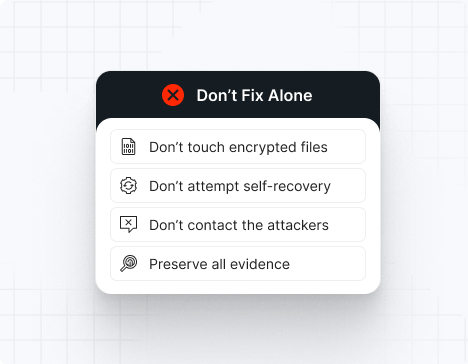
Do NOT attempt any self-remediation, as it can trigger further encryption and destroy recovery points. Instead, follow these steps:
Contact us now for urgent ransomware response assistance, 24/7
Get Help Now
Accomplishments and recognitions, demonstrating our commitment to excellence and innovation.
Momentum Leader in MDR
Best Support in MDR & IR
Managed Detection and Response (MDR)
Top Cybersecurity Company 2025
Best Managed Detection and Response Service
#4 of 184 teams Splunk Boss of the SOC
Best Of Cybersecurity Awards for Q1 2025
AWS Partner
Splunk Manage Premier Partner
Like a crime scene, a ransomware attack must be preserved — tampering with encrypted files, attempting self-recovery, or engaging with attackers can destroy critical evidence and reduce your chances of recovery.
Taking the right steps in the first moments after a Babuk2 attack can make a huge difference and help you make a full recovery. Request 24/7 Babuk2 ransomware recovery services to decrypt your data and maximize your chances of restoring operations.
Babuk2 infections display the .babuk2 file extension and ransom notes titled “How To Restore Your Files.txt” placed prominently on infected systems. Initial compromise vectors trace to phishing, credential theft, and internet-facing application exploitation. The group’s credibility issues mean victims should verify actual encryption occurrence versus ransom note placement.
Babuk2 uses AES-256-CBC for file encryption with RSA-2048 asymmetric key wrapping, matching contemporary ransomware standards. Encryption speed typical for enterprise-scale deployment.
RaaS platform claiming direct descent from original Babuk group (disputed by security researchers). Operators maintain malware infrastructure and leak site. Affiliate recruitment emphasizes "proven" track record and high success rates (claims often unverifiable). Internal disputes have been documented in dark web forums.
Dual extortion with emphasis on operational scale exaggeration. Leak site publishes victim names and data counts; however, security researchers have identified fabricated victim claims (using data from other breaches, fake company logos). Some variants include countdown timers and threatening language about data destruction.
Windows-exclusive: domain controllers, file servers, database servers. No multi-platform variants confirmed.
"How To Restore Your Files.txt" with Tor contact URL, Bitcoin wallet address, and victim ID. Messages reference "proven decryption service" and "professional negotiations team." Some notes include false victim statistics.
No public decryption tool available. Security researchers continue analyzing samples; key recovery unlikely.

File Extensions
.babuk2
Ransom Note Filenames
How To Restore Your Files.txt, BABUK2_RESTORE.txt, Babuk2_Notice.txt
Babuk2 Hashes
Process names: babuk2.exe, ransomware.exe, payment.exe. Observed spawning from Windows Update or system services.
Babuk2 Tools
– EDR Disabling: Windows Defender disable via Group Policy
– Credential Dumping: Mimikatz, SAM registry extraction
– Reconnaissance: Network enumeration, domain discovery
– Exfiltration: Rclone, FTP tools, Mega.nz
– Lateral Movement: Pass-the-Hash, SMB exploitation
– Malware: Emotet/Trickbot for initial access, custom backdoors
Most Common Red Flag
Process logs: PowerShell script execution with encryption operations, Rclone syncing of network shares to cloud storage, unusual service account privilege escalation patterns.
Attack vector | % of Babuk2 incidents | Notes |
Phishing with Trojan | 50% | Emotet/Trickbot delivery |
RDP Brute Force | 30% | Weak credentials |
Internet-Facing App | 15% | Unpatched vulnerabilities |
Supply Chain | 5% | Vendor compromise |
Documented victims: 12–18 organizations (claims of 50+ disputed by researchers). Ransom demands: $30K–$800K. Payment rate: 25–35%. Verification issues: multiple supposed victims confirmed as false/fabricated. Legitimate victims recovered through backup strategies predominantly.
Removal focuses on attacker access elimination: revoke credentials, kill persistence mechanisms, remove backdoors (Emotet/Trickbot components), terminate lateral movement channels, restore from clean backups. Verify actual encryption before paying ransom.
Recovery depends on backup availability. Organizations with clean, tested backups can restore in 2–7 days. Post-recovery: verify backup integrity, implement enhanced monitoring, deploy EDR. Babuk2’s credibility issues suggest backup-first recovery approach over negotiation.
Documented demands: $30,000–$800,000. Average settlement: $100,000–$250,000 after negotiation. Payment legitimacy suspect: some “paid” victims report continued data publication.
10 reasons why you should choose the UnderDefense ransomware recovery consulting services:
Get Help NowBabuk2 is a RaaS operation claiming succession from the original Babuk ransomware group, launched in 2024–2025. The group encrypts files using AES-256-CBC with RSA-2048 wrapping and operates a public leak site. However, Babuk2 has faced significant credibility challenges due to allegations of fabricated victim claims and exaggerated breach statistics.
Attribution is disputed. The original Babuk operation nominally disbanded in 2021 after leadership disputes. Multiple groups have claimed “Babuk 2.0” or “Babuk successor” status. Security researchers have not independently verified a legitimate succession claim, suggesting Babuk2 may be opportunistic rebranding of existing malware infrastructure.
Researchers have identified fabricated victim claims on Babuk2’s leak site: logos doctored, breach descriptions copied from other incidents, victim organization data unverifiable. Some “leaked” files traced to previous public breaches. These discrepancies suggest either internal operational collapse or intentional fraud to inflate perceived power.
Verification steps: 1) Check if organization name appears on confirmed Babuk2 leak site with verifiable data samples; 2) Cross-reference leaked file samples against your known data; 3) Engage forensic investigators to search for encryption/exfiltration indicators; 4) Never trust ransom note claims alone (may be template reuse).
No public decryption tool exists. Theoretical decryption possible through law enforcement key recovery or future research, but unlikely.
Babuk2 threatens data publication on leak site. However, given documented fabrication issues, verify actual data exfiltration before negotiating or paying. Some supposed victims reported no actual data publication despite ransom demands.
1) Block Emotet/Trickbot through email security; 2) Patch internet-facing applications immediately; 3) Disable or heavily monitor RDP; 4) Implement MFA; 5) Deploy EDR; 6) Maintain offline backups; 7) Conduct regular security assessments.
1) Isolate infected systems; 2) Revoke credentials; 3) Scan for Emotet/Trickbot persistence; 4) Preserve forensic evidence; 5) Verify actual data exfiltration (check logs for network reconnaissance and data movement); 6) Notify law enforcement (FBI); 7) Verify backup integrity; 8) Begin recovery if legitimate breach confirmed; 9) Monitor for re-compromise; 10) Post-incident, audit logs for evidence of attacker access duration.
Babuk2’s fabricated victim claims undermine negotiation credibility: if the group has publicly fabricated breaches, how can organizations trust promises to delete stolen data after payment? This incentivizes backup-first recovery approaches over ransom payment, potentially reducing Babuk2’s leverage and profitability.
If Babuk2 fabricates breaches (no actual encryption or exfiltration), payment rewards fraud and incentivizes further deceptive operations. Conversely, legitimate breaches get mixed in with fabricated claims, creating uncertainty. Best practice: verify breach reality through forensics before payment consideration.