Security & Compliance Automation Platform
UnderDefense MAXI is the solution to day-to-day cybersecurity problems of IT leaders and teams. It builds your 24/7 business protection together with you on the driver’s seat.
UnderDefense MAXI Platform
UnderDefense Secures Top Honor at the 2025 Global Infosec Awards
We’re proud of being a winner at the 2025 Global Infosec Awards…
10-Point AWS Security Checklist for Executives
Quickly assess your cloud security posture with this executive-ready checklist covering IAM, monitoring, and compliance essentials.
Anti-Phishing Playbook
Your free PDF guide to spotting and stopping phishing attacks before they reach your team or data.
24/7 Threat Detection & MAXImum Responsiveness
Our human-led MDR service combines expert insight and automation and AI for fast, precise threat response. Get full context in 2 minutes and cut MTTC to 15, staying ahead of ransomware and other attacks.
Calculate your MDR price
Pay only for the services you actually need, with no hidden costs.
10-Point AWS Security Checklist for Executives
Quickly assess your cloud security posture with this executive-ready checklist covering IAM, monitoring, and compliance essentials.
Anti-Phishing Playbook
Your free PDF guide to spotting and stopping phishing attacks before they reach your team or data.
Spot threats faster and respond smarter than tools alone
24/7 MDR and SOC services led by award-winning security experts. We act as an extension to your team or as a fully remote team, providing detailed threat insights and actionable responses to secure your environment immediately.
UnderDefense is an AWS Partner
We’re excited to announce that UnderDefense is now an AWS partner and available on AWS Marketplace…
Managed SOC at Your Service
Augment your SOC with 24/7 monitoring, threat detection, and expert response—without the overhead. Integrated with your existing tools, our SOCaaS stops attacks before they cause harm.
Managed SIEM Pricing Guide
Download a clear, practical overview of Managed SIEM pricing, featuring detailed breakdowns by service type, pricing model, real-world pros and cons, and key cost factors.
Managed SOC at Your Service
Augment your SOC with 24/7 monitoring, threat detection, and expert response—without the overhead. Integrated with your existing tools, our SOCaaS stops attacks before they cause harm.
Managed SIEM Pricing Guide
Download a clear, practical overview of Managed SIEM pricing, featuring detailed breakdowns by service type, pricing model, real-world pros and cons, and key cost factors.

Arvin Club ransomware recovery team on standby
Arvin Club is an emerging ransomware group with reported links to Iranian cybercriminal networks, targeting Israeli and Western organisations primarily through data theft and extortion without file encryption. Do not engage the group or attempt to manage the breach alone — contact UnderDefense's incident response team immediately.
Average Mttc
Ransom-Free recovery rate
Avoided in ransom
Global availability
Systems restored
IR experts
Ransomware cases resolved
IR experience
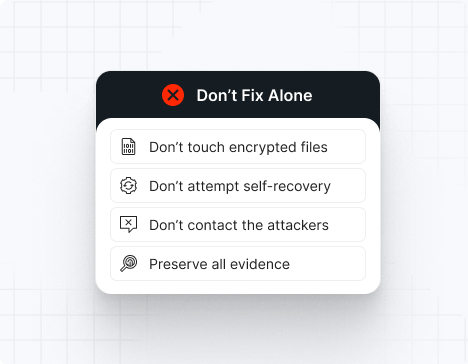
Do NOT attempt any self-remediation, as it can trigger further encryption and destroy recovery points. Instead, follow these steps:
Contact us now for urgent ransomware response assistance, 24/7
Get Help Now
Accomplishments and recognitions, demonstrating our commitment to excellence and innovation.

Momentum Leader in MDR
Best Support in MDR & IR
Managed Detection and Response (MDR)
Top Cybersecurity Company 2025
Best Managed Detection and Response Service
#4 of 184 teams Splunk Boss of the SOC
Best Of Cybersecurity Awards for Q1 2025
AWS Partner
Splunk Manage Premier Partner
Like a crime scene, a ransomware attack must be preserved — tampering with encrypted files, attempting self-recovery, or engaging with attackers can destroy critical evidence and reduce your chances of recovery.
Taking the right steps in the first moments after a Arvin Club attack can make a huge difference and help you make a full recovery. Request 24/7 Arvin Club ransomware recovery services to decrypt your data and maximize your chances of restoring operations.
Arvin Club infections are characterized by file extensions .arvin or .arvinclub and ransom notes named ARVIN_NOTICE.txt or ARVIN_RANSOM.txt. The group’s approach prioritizes data exfiltration over encryption; many victims report data publication without file encryption, indicating extortion-first strategy. Initial compromise traces to phishing, credential theft, and exploitation of internet-facing services.
Arvin Club employs AES-256-GCM encryption when encryption is performed, but notably opts for pure data exfiltration in many incidents, making this ransomware hybrid extortion malware more than traditional ransomware.
Hybrid model combining independent operations with affiliate recruitment. Core team focuses on high-value targets; lower-value opportunities delegated to affiliates. Ideological motivation (anti-Israel sentiment, anti-Western positioning) influences target selection alongside financial incentives.
Data exfiltration-first approach: the group publishes stolen data immediately, then demands ransom for removal from public leak site. Unlike traditional ransomware, encryption is secondary. Psychological leverage emphasizes political/ideological harm alongside financial pressure. Some variants include threatening to notify media and NGOs about victim organizations.
Windows-primary, but reconnaissance identifies Linux servers, cloud infrastructure, and SaaS applications. Supply chain targeting suggests broad platform awareness.
ARVIN_NOTICE.txt or ARVIN_RANSOM.txt with Tor contact URL. Ransom messages often include ideological language: "Your organization's information has been seized as part of [geopolitical cause]." Some notes include media contact information, suggesting public pressure tactics.
No decryption tool exists; recovery relies on backup restoration or negotiation. Some Arvin Club victims never experienced encryption, limiting decryption tool development.
File Extensions
.arvin, .arvinclub, .arvinclub_encrypted
Ransom Note Filenames
ARVIN_NOTICE.txt, ARVIN_RANSOM.txt, ARVIN_DATA_SEIZED.txt
Arvin Club Hashes
Executable names: arvin.exe, club.exe, notification.exe. Process creation from unusual system paths observed.
Arvin Club Tools
– Credential Dumping: Mimikatz, browser credential extraction, SSH key harvesting
– Reconnaissance: Shodan API queries, cloud infrastructure scanning, SaaS application enumeration
– Exfiltration: Rclone, mega.nz, custom SSH tunnels, cloud storage APIs
– Lateral Movement: SSH credential propagation, RDP pivoting, cloud IAM exploitation
– Malware: Qbot for delivery, custom backdoors, supply chain implants
Most Common Red Flag
Process logs showing: Shodan API queries, large-scale cloud storage upload attempts via Rclone: `rclone copy [company-folder] mega://backup`, credential harvesting from browser caches. Git repository theft commands: `git clone [internal-repo]` on compromised systems.
Attack vector | % of Arvin Club incidents | Notes |
Phishing to High-Value Targets | 50% | Executive spear-phishing, credential theft |
Supply Chain Compromise | 30% | Third-party vendor or MSP access |
Cloud Infrastructure Misconfiguration | 15% | AWS/Azure credential exposure, open buckets |
Unpatched Internet-Facing Service | 5% | RCE vulnerability exploitation |
Documented victims: 15–20 organizations (primarily Israeli tech companies, Western financial firms). Data publication rate: 95% (threatening publication before encryption demand). Ransom demands: $100K–$2M. Payment rate: 20–30% (victims skeptical of promises to delete data). Multiple victims experienced data publication despite ransom payment, undermining group credibility.
Removal focuses on attacker access elimination: revoke all credentials; remove SSH keys and backdoors; scan for persistence mechanisms; kill lateral movement infrastructure (RDP sessions, SSH tunnels). Unlike traditional ransomware, removal efficacy depends on stopping data exfiltration rather than decryption capability.
Recovery prioritizes: 1) Stopping data exfiltration immediately, 2) Notification of affected parties (GDPR/legal requirements), 3) Credit monitoring for compromised individuals, 4) Monitoring leak sites for continued publication, 5) Network restoration from clean backups. Significant risk of reputational harm and regulatory penalties even if encryption is not deployed.
Documented demands: $100,000–$2,000,000. Average settlement: $200,000–$400,000. Payment reliability: low; many victims reported data publication even after paying, indicating either scams or operational breaches within the group.
10 reasons why you should choose the UnderDefense ransomware recovery consulting services:
Get Help NowArvin Club is an emerging extortion group (ransomware-adjacent but emphasizing data theft) with suspected ties to Iranian cybercriminals and activist communities. The group primarily targets Israeli and Western organizations and employs data exfiltration-first tactics, publishing stolen information before or instead of deploying encryption. The group has demonstrated ideological motivation alongside financial objectives.
No definitive attribution to Iranian government exists, but operational focus (Israel-targeting, anti-Western positioning), resources, and apparent immunity from Iranian law enforcement suggest possible tacit state support. Intelligence analysis remains inconclusive.
Data exfiltration creates immediate, verifiable harm and leverage: victims know their data is public. Encryption can be circumvented through backups, but published data cannot be undone. The strategy maximizes ransom probability through irreversible reputational/regulatory damage.
Documented victims: technology companies, financial services, Israeli defense contractors, Western intelligence-adjacent organizations. Targeting suggests deliberate strategic selection rather than opportunistic victim choice.
Negotiation is risky; documented cases show data publication despite ransom payment, suggesting either operational unreliability or intentional breach of agreements. Law enforcement advises against payment and recommends incident response focus on notification and damage control.
Victims report theft of: source code, technical documentation, customer lists, employee records, financial data, contracts, intellectual property. Supply chain targeting suggests interest in procurement data and vendor relationships.
1) Implement email security with credential stealer sandboxing; 2) Patch internet-facing services immediately; 3) Enforce MFA on all authentication; 4) Monitor for unusual data access and exfiltration patterns; 5) Implement DLP (Data Loss Prevention) for sensitive asset tracking; 6) Segment networks isolating critical systems; 7) Monitor dark web for organizational mentions; 8) Establish incident response procedures for data breach scenarios.
1) Assume data is compromised; begin breach notification procedures immediately; 2) Preserve forensic evidence (access logs, authentication records); 3) Assess data exfiltration scope (what was stolen, how much); 4) Notify law enforcement (FBI for US victims); 5) Engage legal counsel for regulatory notification requirements; 6) Revoke all credentials; 7) Monitor leak sites for data publication; 8) Implement credit monitoring for affected individuals; 9) Public disclosure of incident scope and timeline; 10) Post-incident, implement DLP and enhanced monitoring.
Supply chain compromise provides multiplier effect: accessing one vendor grants access to many customer organizations. A single MSP compromise could affect 50+ client organizations. The strategy dramatically increases attack reach without proportional resource investment.
Traditional ransomware encrypts files (making them inaccessible) and demands ransom for decryption. Arvin Club publishes data (making it public) and demands ransom for deletion/public request removal. Publication cannot be undone, making data breach notification mandatory regardless of payment, fundamentally changing the incident response calculus.