Security & Compliance Automation Platform
UnderDefense MAXI is the solution to day-to-day cybersecurity problems of IT leaders and teams. It builds your 24/7 business protection together with you on the driver’s seat.
UnderDefense MAXI Platform
UnderDefense Secures Top Honor at the 2025 Global Infosec Awards
We’re proud of being a winner at the 2025 Global Infosec Awards…
10-Point AWS Security Checklist for Executives
Quickly assess your cloud security posture with this executive-ready checklist covering IAM, monitoring, and compliance essentials.
Anti-Phishing Playbook
Your free PDF guide to spotting and stopping phishing attacks before they reach your team or data.
24/7 Threat Detection & MAXImum Responsiveness
Our human-led MDR service combines expert insight and automation and AI for fast, precise threat response. Get full context in 2 minutes and cut MTTC to 15, staying ahead of ransomware and other attacks.
Calculate your MDR price
Pay only for the services you actually need, with no hidden costs.
10-Point AWS Security Checklist for Executives
Quickly assess your cloud security posture with this executive-ready checklist covering IAM, monitoring, and compliance essentials.
Anti-Phishing Playbook
Your free PDF guide to spotting and stopping phishing attacks before they reach your team or data.
Spot threats faster and respond smarter than tools alone
24/7 MDR and SOC services led by award-winning security experts. We act as an extension to your team or as a fully remote team, providing detailed threat insights and actionable responses to secure your environment immediately.
UnderDefense is an AWS Partner
We’re excited to announce that UnderDefense is now an AWS partner and available on AWS Marketplace…
Managed SOC at Your Service
Augment your SOC with 24/7 monitoring, threat detection, and expert response—without the overhead. Integrated with your existing tools, our SOCaaS stops attacks before they cause harm.
Managed SIEM Pricing Guide
Download a clear, practical overview of Managed SIEM pricing, featuring detailed breakdowns by service type, pricing model, real-world pros and cons, and key cost factors.
Managed SOC at Your Service
Augment your SOC with 24/7 monitoring, threat detection, and expert response—without the overhead. Integrated with your existing tools, our SOCaaS stops attacks before they cause harm.
Managed SIEM Pricing Guide
Download a clear, practical overview of Managed SIEM pricing, featuring detailed breakdowns by service type, pricing model, real-world pros and cons, and key cost factors.
Arkana ransomware recovery team on standby
Arkana gained notoriety in early 2025 by claiming a breach of WideOpenWest (WOW), one of the largest US cable operators, allegedly exposing data on 2.2 million customers. Isolate affected systems immediately and contact UnderDefense's incident response team — do not attempt containment or negotiation without expert guidance.
Average Mttc
Ransom-Free recovery rate
Avoided in ransom
Global availability
Systems restored
IR experts
Ransomware cases resolved
IR experience
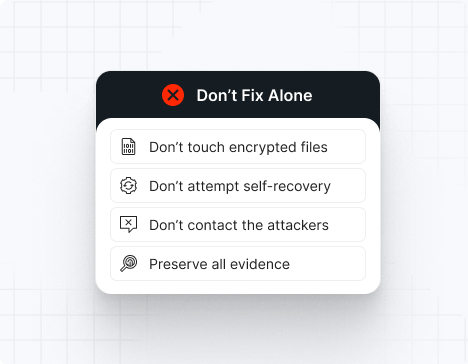
Do NOT attempt any self-remediation, as it can trigger further encryption and destroy recovery points. Instead, follow these steps:
Contact us now for urgent ransomware response assistance, 24/7
Get Help Now
Accomplishments and recognitions, demonstrating our commitment to excellence and innovation.

Momentum Leader in MDR
Best Support in MDR & IR
Managed Detection and Response (MDR)
Top Cybersecurity Company 2025
Best Managed Detection and Response Service
#4 of 184 teams Splunk Boss of the SOC
Best Of Cybersecurity Awards for Q1 2025
AWS Partner
Splunk Manage Premier Partner
Like a crime scene, a ransomware attack must be preserved — tampering with encrypted files, attempting self-recovery, or engaging with attackers can destroy critical evidence and reduce your chances of recovery.
Taking the right steps in the first moments after a Arkana attack can make a huge difference and help you make a full recovery. Request 24/7 Arkana ransomware recovery services to decrypt your data and maximize your chances of restoring operations.
Arkana victims show IOCs including evidence of infostealer infections on endpoints, compromised employee credentials, unauthorized access to cloud platforms (AppianCloud, Symphonica), and lateral movement patterns indicating administrative access abuse. Watch for unusual database export activity, bulk credential theft evidence, and data staging in cloud storage or temporary directories. Ransom notes reference specific exfiltrated data volumes and threaten publication of customer data and executive personal information.
Arkana deploys RSA+AES encryption combined with a custom stealer component (POORTRY/STONESTOP-style). The encryption methodology remains partially unclear; focus on behavioral detection of credential theft and unauthorized data access rather than encryption signature analysis.
Arkana operates as a hybrid threat combining infostealer deployment with traditional ransomware encryption and custom data theft components. The group demonstrates sophisticated understanding of target environments, particularly telecom and ISP infrastructure. Double extortion is standard: data theft combined with encryption and threats to expose customer and executive personal information. The group is reportedly linked to the Qilin RaaS ecosystem.
Primary leverage combines data publication threats with operational disruption through encryption. The group publishes stolen data on Tor leak sites and specifically targets executive personal information (addresses, social security numbers, contact details) for doxxing pressure. Customer data publication threats create regulatory and reputational pressure on victim organizations. The group demonstrates willingness to maintain prolonged negotiations.
Arkana targets large US telecommunications and ISP organizations with focus on accessing customer databases and executive information. Cloud platform compromise (AppianCloud, Symphonica) suggests sophisticated understanding of enterprise cloud deployments. The group prioritizes organizations managing millions of customer records and critical communication infrastructure.
Ransom notes containing victim-specific data volumes, encryption details, and threats reference leaked customer data and executive personal information. Notes include Tor onion site URLs and cryptocurrency wallet addresses. The group demonstrates willingness to provide negotiation channels and extended discussion periods.
No public decryption tool is available for Arkana. The malware uses strong RSA+AES encryption with private keys held exclusively by the threat actor. Decryption requires ransom payment (with no guarantee of functionality) or restoration from clean backups. The WOW incident did not result in public decryption tool release.
Specific indicators include evidence of infostealer infection on endpoints, compromised AppianCloud and Symphonica credentials, unauthorized database export activity, bulk user data staging, and connections to Arkana’s Tor infrastructure. File extension patterns vary; focus on behavioral detection of credential theft and data exfiltration.
File Extensions
Not standardized across Arkana incidents. The WOW attack focused on data theft via cloud platforms with limited traditional ransomware deployment details publicly available.
Ransom Note Filenames
Limited public information available on specific filenames. WOW breach notification occurred primarily via Tor leak site publication and direct contact rather than on-system ransom notes.
Arkana Hashes
Limited technical sample analysis available due to the group’s recent emergence. Custom stealer components (POORTRY/STONESTOP-style) require behavioral analysis rather than hash-based detection.
Arkana Tools
Legitimate administrative tools: RDP, cloud platform management consoles; infostealer malware (custom POORTRY/STONESTOP variants); data exfiltration utilities; PowerShell; custom encryption payloads; Tor infrastructure for communication.
Most Common Red Flag (Commands)
Evidence of infostealer execution and credential theft, unauthorized access to AppianCloud and Symphonica administrative consoles, database export commands (SQL queries for customer data extraction), bulk file transfers to cloud storage or external systems, unusual administrator account usage patterns.
Attack vector | % of Arkana incidents | Notes |
Infostealer Infection (Initial) | 60% | Malware stealing credentials from compromised endpoints |
Phishing & Credential Harvesting | 20% | Email-based attacks targeting employee credentials |
Weak Cloud Account Credentials | 15% | Compromised cloud platform authentication |
Unpatched Vulnerabilities | 5% | Exploitation of cloud platform CVEs |
WideOpenWest (WOW) breach resulted in exposure of 403,000 and 2.2 million customer records with sensitive information including usernames, passwords, security details, and Firebase integration data. CEO personal information (address, SSN, contact details) was published for doxxing. Recovery timeline estimated at 6–8 weeks. Settlement terms remain confidential; ransom demand estimated at multi-million-dollar range.
Immediately isolate compromised employee endpoints and cloud-connected systems. Preserve forensic evidence of infostealer infection and credential theft. Reset all user and administrative credentials for cloud platforms (AppianCloud, Symphonica) and internal systems. Preserve all exfiltrated data evidence for law enforcement investigation. Restore cloud configurations and data from verified clean backup repositories predating the incident. Conduct comprehensive endpoint threat hunting to identify persistence mechanisms and secondary malware installations.
Restore all systems and cloud configurations from verified clean backup repositories. Rebuild all user credentials and implement multi-factor authentication on all cloud platform and administrative accounts. Deploy endpoint detection and response (EDR) solutions to detect infostealer malware and credential theft activity. Implement network segmentation to restrict cloud platform access to authorized personnel. Deploy data loss prevention (DLP) tools to monitor for unauthorized database exports and bulk credential transfers. Maintain immutable backup copies to prevent future encryption of recovery infrastructure.
Arkana demands for the WOW breach estimated at $5–10 million based on customer data volume and incident scope. ISP and telecom organizations with millions of customer records face demands in the multi-million-dollar range. Negotiated settlements for similar incidents typically reduce initial demands by 40–60%.
10 reasons why you should choose the UnderDefense ransomware recovery consulting services:
Get Help NowArkana is an emerging ransomware group operating since early 2025, specializing in breaching US telecommunications and ISP providers. The group combines traditional encryption with sophisticated credential theft via custom infostealer malware (POORTRY/STONESTOP-style) and subsequent double extortion. Arkana gained notoriety through the WideOpenWest (WOW) breach affecting 2.2 million customer records, with additional threats including doxxing of executive personal information. The group has been linked to the Qilin RaaS ecosystem, suggesting possible operational alignment with larger threat actor infrastructure.
The Arkana threat actor’s geographic origin is unconfirmed but potential linkage to the Qilin RaaS ecosystem suggests Russian-speaking operators with possible Russian or Eastern European base of operations. Operational sophistication and understanding of US telecom infrastructure suggest international operators with significant technical capability. Law enforcement has not publicly attributed Arkana to specific nation-states.
Arkana attacks follow a staged approach: Infostealer malware deployment on employee endpoints (via phishing or supply chain compromise) beginning in September 2024 in the WOW incident. Credential theft from compromised endpoints including cloud platform credentials, VPN access, and administrative accounts. Lateral movement to cloud platforms (AppianCloud, Symphonica) using stolen credentials. Reconnaissance to identify customer databases, executive information, and critical systems. Bulk data exfiltration of customer records, personal information, and sensitive configurations. File encryption deployment across critical systems. Ransom note deployment. Victim notification via Tor leak site publication and direct contact with threats of customer and executive data publication.
Arkana campaigns typically span several months from initial infostealer infection to full network compromise and data exfiltration. The WOW incident involved infostealer infection in September 2024 with full breach discovery occurring approximately 6 months later (March 2025), indicating prolonged dwell time. Rapid lateral movement and data exfiltration typically occurs over 2–4 weeks once credentials are obtained and cloud platform access is established.
No public decryption tools are available for Arkana. The malware uses strong RSA+AES encryption with private keys held exclusively by the threat actor. Decryption requires ransom payment (with no guarantee of functionality) or restoration from clean backups. The WOW incident did not result in public tool releases.
Payment does not guarantee complete decryption or data deletion. Exfiltrated data may still be published or sold despite ransom payment. The group has demonstrated willingness to accept negotiated settlements below initial demands. Payment increases likelihood of future targeting and demonstrates financial capability to the threat actor ecosystem.
Implement multi-factor authentication on all user accounts and cloud platform access. Deploy endpoint detection and response (EDR) solutions to detect infostealer malware and credential theft activity. Conduct regular security awareness training focused on phishing recognition. Monitor cloud platform access logs for unauthorized logins and administrative activity. Segment networks to restrict access to customer databases and sensitive information. Implement data loss prevention (DLP) tools to monitor for unauthorized database exports. Monitor dark web for your organization’s appearance on Arkana leak sites.
– Audit all cloud platform credentials and implement multi-factor authentication – Deploy endpoint detection and response (EDR) on all user systems – Monitor for infostealer malware and credential theft artifacts – Enable cloud platform access logging and anomaly detection – Restrict access to customer databases to minimal necessary personnel – Implement data loss prevention on sensitive database repositories – Monitor Tor leak sites for your organization’s appearance – Engage law enforcement and incident response immediately
Arkana demonstrates strong preference for US telecommunications and ISP organizations, with confirmed targeting of WideOpenWest and suggested targeting of other telecom providers. The focus on organizations managing millions of customer records and critical communication infrastructure suggests deliberate sector specialization. The group appears to prioritize organizations with significant regulatory exposure and customer notification requirements.
Arkana’s publication of executive personal information (addresses, social security numbers, contact details) represents escalation in pressure tactics. Doxxing creates personal risk for executives, generates media attention, and increases organizational pressure to pay ransoms. This tactic particularly impacts telecom/ISP organizations where executive visibility and personal security become direct concerns. The tactic suggests sophisticated understanding of organizational pressure points and decision-making processes.