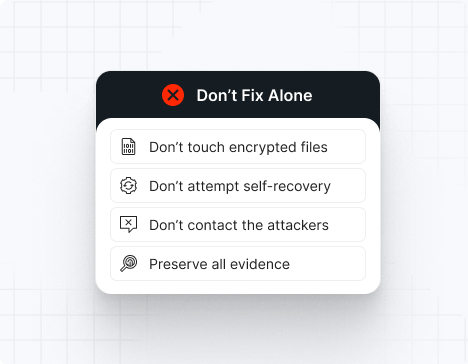
What to do if you're hit by ransomware?

Do NOT attempt any self-remediation, as it can trigger further encryption and destroy recovery points. Instead, follow these steps:

1
Do NOT fix it yourself
2
Disconnect affected systems
3
Call us +1 332 331 8700

Contact us now for urgent ransomware response assistance, 24/7

Get Help Now
Frame

Experts. Finalists. Winners.

Accomplishments and recognitions, demonstrating our commitment to excellence and innovation.

Momentum Leader in MDR

Best Support in MDR & IR

Managed Detection and Response (MDR)

Top Cybersecurity Company 
2025

Best Managed Detection and Response Service

#4 of 184 teams Splunk Boss of the SOC

Best Of Cybersecurity Awards for Q1 2025

AWS Partner

Splunk Manage Premier Partner

Image (11) (1)

Why you shouldn’t attempt 
to fix it alone

Like a crime scene, a ransomware attack must be preserved — tampering with encrypted files, attempting self-recovery, or engaging with attackers can destroy critical evidence and reduce your chances of recovery.

Taking the right steps in the first moments after a Apos attack can make a huge difference and help you make a full recovery. Request 24/7 Apos ransomware recovery services to decrypt your data and maximize your chances of restoring operations.

Contact us now for urgent ransomware recovery assistance

Under attack?

Get Help Now

Apos ransomware statistics & facts

Apos Decryptor
Apos IOCs
Apos Attack Vectors
Case Outcomes
How to Remove Apos Ransomware?
How to Recover from Apos Ransomware?
Ransom Amounts
Apos Decryptor

No decryption tool required for Apos as the group does not encrypt files. Recovery focuses on threat containment, network segmentation, and data preservation for regulatory compliance and law enforcement investigation.

Apos IOCs

Indicators include compromised credentials with unusual access patterns, evidence of data staging in temporary directories or cloud storage, bulk database export activity, connections to Apos Tor infrastructure, and network reconnaissance targeting sensitive data repositories.

File Extensions
None (data-theft-only model; no file encryption deployed). Focus on behavioral detection of data access and transfer patterns rather than file extension analysis.

Ransom Note Filenames
No ransom note files created. Victims are notified via appearance on Apos leak site at apos-leak[.]onion or similar Tor addresses.

Apos Hashes
Limited technical sample analysis available. Apos relies on legitimate tools rather than custom malware, making hash-based detection unreliable. Behavioral analysis required.

Apos Tools
Legitimate administrative tools: RDP, WinRM, PowerShell; data export utilities; cloud storage integration tools; file compression utilities (7-Zip, WinRAR); credential enumeration tools; open-source data exfiltration frameworks.

Most Common Red Flag (Commands)
PowerShell commands: Get-ChildItem -Recurse, Copy-Item for bulk data staging, database export commands (SQL queries), compression utilities for bundling data, cloud storage upload commands, evidence of credential enumeration (Get-ADUser, Get-LocalUser).

Apos Attack Vectors

Attack vector

% of Apos incidents

Notes

Exposed Remote Access Services

45%

Weak credentials on RDP, VPN, or cloud portals

Phishing & Credential Theft

30%

Email-based credential harvesting campaigns

Compromised Third-Party Access

15%

Partner or vendor account compromise

Unpatched Vulnerabilities

10%

Exploitation of known application CVEs

Powered By WP Table Builder
Case Outcomes

Apos claimed approximately 4 victims before operational activity tapered in late 2024. Limited public information available on victim names, industries, or settlement terms. Recovery timelines for data-theft-only incidents averaged 2–4 weeks post-detection focused on threat containment rather than decryption recovery.

How to Remove Apos Ransomware?

Since Apos does not deploy encryption, “removal” focuses on threat containment and forensic preservation. Immediately isolate systems showing data exfiltration evidence. Reset compromised credentials and audit access logs. Preserve all forensic evidence of unauthorized access and data staging. Conduct network segmentation to prevent continued lateral movement. Implement enhanced monitoring to detect ongoing exfiltration attempts. Engage law enforcement and cyber insurance for breach investigation coordination.

How to Recover from Apos Ransomware?

Recovery focuses on data preservation for regulatory compliance and breach notification. Conduct comprehensive security assessment to identify all compromised systems and accessed data. Implement enhanced monitoring to detect unauthorized access attempts. Deploy data loss prevention (DLP) tools to prevent future exfiltration. Rebuild user credentials and implement multi-factor authentication. Notify affected individuals per regulatory requirements (GDPR, HIPAA, CCPA, etc.). Engage credit monitoring services if PII or financial data was exposed. Establish incident response procedures for future data breach scenarios.

Ransom Amounts

Limited data available due to limited victim count and activity tapering. Initial affiliate recruitment materials suggested demands would be customized to victim organization size and data sensitivity. Estimated ranges for comparable data-theft-only operations suggest $50,000 to $2,000,000+ depending on data value.

Our customers say it best

Contact us now for urgent ransomware recovery assistance

Under attack?

Get Help Now

Frequently asked questions

What is Apos Ransomware?

Apos is a data-broker/leak-only threat actor that emerged in April 2024, operating without traditional file encryption. The group exfiltrates sensitive data and threatens publication to coerce ransom payments. Apos offered RaaS affiliate programs but appears to have operated with limited affiliate activity. The group focused on organizations managing valuable data across multiple sectors and geographic regions. Operational activity appears to have significantly tapered by late 2024, suggesting possible short-lived operation or strategic business model changes.

Where is the Apos Gang Located?

The Apos threat actor’s geographic origin is uncertain. Language analysis and operational patterns suggest potential Russian-speaking operators, but attribution remains speculative. The group’s global targeting and multi-language leak site suggest distributed operations with possible multinational operators. Law enforcement has not publicly attributed Apos to specific geographic regions or nation-states.

How Does Apos Ransomware Work?

Apos operates without traditional ransomware encryption: Initial access via exposed remote services or phishing-based credential harvesting. Lateral movement through target networks using compromised credentials and legitimate administrative tools. Reconnaissance to identify sensitive data repositories and valuable information. Data exfiltration to attacker-controlled servers or cloud storage of databases, customer information, and proprietary data. Victim notification via appearance on Apos’ Tor leak site threatening data publication. Ransom negotiation via Tor-based messaging or advertised email addresses. No operational disruption through encryption; pressure relies entirely on data publication threats.

How Long Does an Apos Attack Take?

Apos campaigns typically span 1–3 weeks from initial access to data exfiltration. The group appears to conduct limited reconnaissance, focusing on rapid identification of data repositories and quick extraction. No encryption phase required; operational timeline is shorter than traditional ransomware campaigns. Victim notification occurs immediately upon data exfiltration completion.

Can Apos Ransomware Be Decrypted?

Since Apos does not encrypt files, decryption is not applicable. Recovery depends on threat containment and regulatory compliance notification. The exposure of exfiltrated data cannot be “recovered” through technical means; focus shifts to damage limitation and legal/regulatory response.

What Happens If You Pay the Apos Ransom?

Limited historical data available due to small victim count. Based on patterns from similar threat actors, payment does not guarantee data deletion. Exfiltrated information may still be sold to competitors, published on dark web marketplaces, or shared with other threat actors. The group operates under no enforceable contracts.

How to Prevent Apos Infection?

Implement multi-factor authentication on all remote access services and user accounts. Deploy endpoint detection and response (EDR) tools to monitor for lateral movement and data exfiltration. Conduct regular security awareness training on phishing and credential security. Segment networks to restrict access to sensitive data repositories. Implement data loss prevention (DLP) tools to alert on unauthorized bulk data access and transfers. Maintain regular backups (not relevant for encryption recovery, but important for availability). Monitor dark web for your organization’s appearance on Apos leak sites.

Apos Threat Checklist

– Implement multi-factor authentication on all accounts – Audit and strengthen remote access credentials – Monitor for unusual credential enumeration activity – Detect bulk data access and file transfer patterns – Enable network segmentation for sensitive data access – Deploy data loss prevention tools on critical repositories – Monitor for connections to Apos Tor infrastructure – Engage dark web monitoring services for breach notification

Does Apos Target Specific Industries?

Apos demonstrates no strong sector specialization. The group targeted technology, healthcare, manufacturing, business services, and telecommunications organizations across multiple geographic regions. Targeting appears financially motivated based on perceived data value rather than sector expertise or strategic focus.

Why Did Apos Activity Taper in Late 2024?

Apos’ significant operational decline or cessation by late 2024 suggests several possibilities: possible law enforcement pressure, business model challenges (difficulty converting data theft to payment), leadership transitions, or rebranding under new threat actor names. The group’s short operational lifespan (April–late 2024) may indicate experimentation with ransomware business models rather than sustained operations.