Security & Compliance Automation Platform
UnderDefense MAXI is the solution to day-to-day cybersecurity problems of IT leaders and teams. It builds your 24/7 business protection together with you on the driver’s seat.
UnderDefense MAXI Platform
UnderDefense Secures Top Honor at the 2025 Global Infosec Awards
We’re proud of being a winner at the 2025 Global Infosec Awards…
10-Point AWS Security Checklist for Executives
Quickly assess your cloud security posture with this executive-ready checklist covering IAM, monitoring, and compliance essentials.
Anti-Phishing Playbook
Your free PDF guide to spotting and stopping phishing attacks before they reach your team or data.
24/7 Threat Detection & MAXImum Responsiveness
Our human-led MDR service combines expert insight and automation and AI for fast, precise threat response. Get full context in 2 minutes and cut MTTC to 15, staying ahead of ransomware and other attacks.
Calculate your MDR price
Pay only for the services you actually need, with no hidden costs.
10-Point AWS Security Checklist for Executives
Quickly assess your cloud security posture with this executive-ready checklist covering IAM, monitoring, and compliance essentials.
Anti-Phishing Playbook
Your free PDF guide to spotting and stopping phishing attacks before they reach your team or data.
Spot threats faster and respond smarter than tools alone
24/7 MDR and SOC services led by award-winning security experts. We act as an extension to your team or as a fully remote team, providing detailed threat insights and actionable responses to secure your environment immediately.
UnderDefense is an AWS Partner
We’re excited to announce that UnderDefense is now an AWS partner and available on AWS Marketplace…
Managed SOC at Your Service
Augment your SOC with 24/7 monitoring, threat detection, and expert response—without the overhead. Integrated with your existing tools, our SOCaaS stops attacks before they cause harm.
Managed SIEM Pricing Guide
Download a clear, practical overview of Managed SIEM pricing, featuring detailed breakdowns by service type, pricing model, real-world pros and cons, and key cost factors.
Managed SOC at Your Service
Augment your SOC with 24/7 monitoring, threat detection, and expert response—without the overhead. Integrated with your existing tools, our SOCaaS stops attacks before they cause harm.
Managed SIEM Pricing Guide
Download a clear, practical overview of Managed SIEM pricing, featuring detailed breakdowns by service type, pricing model, real-world pros and cons, and key cost factors.

AlphaLocker ransomware recovery team on standby
AlphaLocker is an emerging ransomware group active since 2024, targeting small-to-medium enterprises with a streamlined double-extortion model and a low-cost RaaS subscription designed to lower the barrier for affiliates. Isolate affected systems immediately and contact UnderDefense's incident response team — do not attempt recovery or negotiation without expert support.
Average Mttc
Ransom-Free recovery rate
Avoided in ransom
Global availability
Systems restored
IR experts
Ransomware cases resolved
IR experience
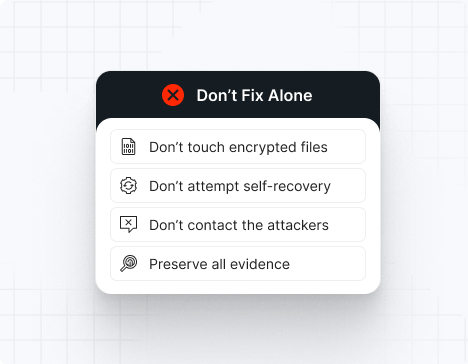
Do NOT attempt any self-remediation, as it can trigger further encryption and destroy recovery points. Instead, follow these steps:
Contact us now for urgent ransomware response assistance, 24/7
Get Help Now
Accomplishments and recognitions, demonstrating our commitment to excellence and innovation.
Momentum Leader in MDR
Best Support in MDR & IR
Managed Detection and Response (MDR)
Top Cybersecurity Company 2025
Best Managed Detection and Response Service
#4 of 184 teams Splunk Boss of the SOC
Best Of Cybersecurity Awards for Q1 2025
AWS Partner
Splunk Manage Premier Partner
Like a crime scene, a ransomware attack must be preserved — tampering with encrypted files, attempting self-recovery, or engaging with attackers can destroy critical evidence and reduce your chances of recovery.
Taking the right steps in the first moments after a AlphaLocker attack can make a huge difference and help you make a full recovery. Request 24/7 AlphaLocker ransomware recovery services to decrypt your data and maximize your chances of restoring operations.
AlphaLocker infections present with file extensions .alphalock or .alpha_locked and ransom notes named ALPHA_RECOVERY.txt or AlphaLocker_README.txt. Initial compromise vectors trace to phishing campaigns, credential theft, and exploitation of internet-facing applications. The malware exhibits standard ransomware behavior: data exfiltration followed by encryption deployment.
AlphaLocker utilizes AES-256-CBC for symmetric encryption combined with RSA-2048 asymmetric key wrapping. Encryption speed is moderate, typically completing across enterprise networks in 4–8 hours.
Pure RaaS model with affiliate recruitment through dark web forums. Operators maintain malware development, leak site, and negotiation infrastructure. Affiliate entry fees range $2,000–$5,000. Payment splits favor operators (60–70% to operators, 30–40% to affiliates).
Dual extortion: file encryption coupled with data exfiltration threats. Leak site publishes victim organization names, employee counts, and data sample previews. Ransom countdown timers default to 7 days before public disclosure.
Windows-only targeting, though reconnaissance may identify Linux servers. Primary focus: Windows domain controllers, file servers, and business-critical systems.
ALPHA_RECOVERY.txt or AlphaLocker_README.txt files placed on desktop and network shares. Standard format: contact URL via Tor, Bitcoin wallet address, victim ID number, and deadline for payment.
No public decryption tool available. Security researchers continue monitoring AlphaLocker samples for potential weaknesses.
File Extensions
.alphalock, .alpha_locked, .AlphaLocker
Ransom Note Filenames
ALPHA_RECOVERY.txt, AlphaLocker_README.txt, RESTORE_DATA_ALPHA.txt
AlphaLocker Hashes
Common executable names: alphalock.exe, ransomware.exe, update.exe. Process creation through legitimate system paths observed.
AlphaLocker Tools
– EDR Disabling: Windows Defender disable via PowerShell, service termination
– Credential Dumping: Mimikatz, LSASS memory dumps, registry hive extraction
– Reconnaissance: Network mapper tools, domain enumeration (BloodHound)
– Exfiltration: Rclone, FTP exfiltration, Mega.nz integration
– Lateral Movement: Pass-the-Hash, SMB exploitation, RDP pivoting
– Malware: Emotet for initial delivery, Cobalt Strike for persistence
Most Common Red Flag
Process logs showing: `powershell.exe -Command “Disable-MpPreference -DisableRealtimeMonitoring $true”` (EDR disable), followed by `secretsdump.py` execution, then RDP lateral movement sequences. Rclone activity: `rclone sync C:\ mega://backup`
Attack vector | % of AlphaLocker incidents | Notes |
Phishing with Credential Stealer | 45% | Emotet/malware attachment delivery |
Unpatched Internet-Facing App | 30% | RCE vulnerability exploitation |
Weak RDP Credentials | 20% | Brute-force or purchased credentials |
Supply Chain | 5% | MSP or vendor compromise |
Approximately 25–30 documented victims since emergence (late 2024). Ransom demands: $50K–$1.2M. Payment rate: 40–50%. Recovery statistics: 35% restored from backups, 15% negotiated settlements with lower payments.
Post-encryption removal focuses on attacker access elimination: revoke all credentials; terminate RDP sessions and Cobalt Strike beacons; remove persistence mechanisms (scheduled tasks, WMI subscriptions, registry modifications); scan for secondary malware (Emotet dropper components); restore from clean backups isolated from network.
Recovery depends on backup strategy maturity. Organizations with versioned backups can restore in 2–5 days. Those without adequate backups face weeks of recovery or total loss. Post-recovery: implement backup verification procedures, enhanced monitoring for lateral movement, and EDR deployment on critical systems.
Documented demands: $50,000–$1,200,000. Average settlement: $250,000–$400,000 after negotiation. Payment decline rates: 50–60% from initial demand.
10 reasons why you should choose the UnderDefense ransomware recovery consulting services:
Get Help NowAlphaLocker is an emerging RaaS ransomware operation launched in late 2024, using AES-256-CBC encryption with RSA-2048 key wrapping. The group operates a public leak site and recruits affiliates through dark web forums. Early targeting suggests focus on mid-market enterprises in finance, manufacturing, and professional services.
Threat intelligence suggests potential links to defunct ransomware infrastructure, indicating possible rebranding or succession planning by established cybercriminals. No definitive attribution to known threat groups published.
The group recruits through dark web forums, offering RaaS with $2,000–$5,000 entry fees. Affiliate program documentation promises 30–40% commission on ransom payments and technical support for deployment and negotiation.
AlphaLocker shows no sector restrictions; documented victims span finance (banks, investment firms), manufacturing (industrial equipment), and professional services (accounting, consulting). Victim selection appears opportunistic rather than strategic.
No public decryption tool exists. The only options are negotiation, backup restoration, or law enforcement key recovery (extremely rare).
Stolen data is published on the leak site within 7 days. AlphaLocker has followed through on approximately 90% of documented disclosure threats, making non-payment extremely risky from reputational standpoint.
1) Implement email security with malware sandboxing to block Emotet; 2) Patch all internet-facing applications immediately upon release; 3) Disable or heavily monitor RDP when not essential; 4) Implement MFA on remote access; 5) Deploy EDR with behavioral analysis; 6) Maintain offline backups; 7) Conduct quarterly security assessments; 8) Monitor for unusual credential usage patterns.
1) Isolate affected systems immediately; 2) Revoke all credentials; 3) Scan for Emotet and Cobalt Strike persistence; 4) Preserve forensic evidence; 5) Assess data exfiltration scope; 6) Verify backup integrity; 7) Notify law enforcement; 8) Engage incident response team; 9) Begin recovery from clean backups; 10) Deploy enhanced monitoring post-recovery; 11) Monitor for re-compromise indicators.
AlphaLocker typically completes encryption across enterprise networks in 4–8 hours from initial access, assuming no security controls trigger earlier detection. Organizations with effective EDR and response procedures may detect and stop the attack within 2–3 hours.
AlphaLocker’s operational efficiency and technical sophistication suggest experienced operators launching a new brand rather than novices. The group’s rapid adoption of standard RaaS practices and affiliate recruitment indicates either previous ransomware experience or acquisition of existing infrastructure from defunct operations.