Security & Compliance Automation Platform
UnderDefense MAXI is the solution to day-to-day cybersecurity problems of IT leaders and teams. It builds your 24/7 business protection together with you on the driver’s seat.
UnderDefense MAXI Platform
UnderDefense Secures Top Honor at the 2025 Global Infosec Awards
We’re proud of being a winner at the 2025 Global Infosec Awards…
10-Point AWS Security Checklist for Executives
Quickly assess your cloud security posture with this executive-ready checklist covering IAM, monitoring, and compliance essentials.
Anti-Phishing Playbook
Your free PDF guide to spotting and stopping phishing attacks before they reach your team or data.
24/7 Threat Detection & MAXImum Responsiveness
Our human-led MDR service combines expert insight and automation and AI for fast, precise threat response. Get full context in 2 minutes and cut MTTC to 15, staying ahead of ransomware and other attacks.
Calculate your MDR price
Pay only for the services you actually need, with no hidden costs.
10-Point AWS Security Checklist for Executives
Quickly assess your cloud security posture with this executive-ready checklist covering IAM, monitoring, and compliance essentials.
Anti-Phishing Playbook
Your free PDF guide to spotting and stopping phishing attacks before they reach your team or data.
Spot threats faster and respond smarter than tools alone
24/7 MDR and SOC services led by award-winning security experts. We act as an extension to your team or as a fully remote team, providing detailed threat insights and actionable responses to secure your environment immediately.
UnderDefense is an AWS Partner
We’re excited to announce that UnderDefense is now an AWS partner and available on AWS Marketplace…
Managed SOC at Your Service
Augment your SOC with 24/7 monitoring, threat detection, and expert response—without the overhead. Integrated with your existing tools, our SOCaaS stops attacks before they cause harm.
Managed SIEM Pricing Guide
Download a clear, practical overview of Managed SIEM pricing, featuring detailed breakdowns by service type, pricing model, real-world pros and cons, and key cost factors.
Managed SOC at Your Service
Augment your SOC with 24/7 monitoring, threat detection, and expert response—without the overhead. Integrated with your existing tools, our SOCaaS stops attacks before they cause harm.
Managed SIEM Pricing Guide
Download a clear, practical overview of Managed SIEM pricing, featuring detailed breakdowns by service type, pricing model, real-world pros and cons, and key cost factors.

Lynx ransomware recovery team on standby
Do NOT attempt to decrypt files or negotiate with attackers on your own—this can worsen the situation and risk permanent data loss. Instead, immediately isolate affected systems and engage UnderDefense’s rapid incident response team to contain the Lynx ransomware attack and restore your operations with expert guidance.
Average Mttc
Ransom-Free recovery rate
Avoided in ransom
Global availability
Systems restored
IR experts
Ransomware cases resolved
IR experience
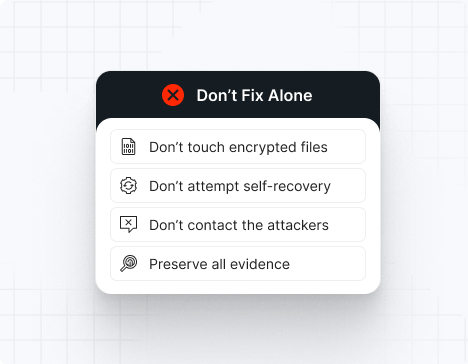
Do NOT attempt any self-remediation, as it can trigger further encryption and destroy recovery points. Instead, follow these steps:
Contact us now for urgent ransomware response assistance, 24/7
Get Help Now
Accomplishments and recognitions, demonstrating our commitment to excellence and innovation.
Momentum Leader in MDR
Best Support in MDR & IR
Managed Detection and Response (MDR)
Top Cybersecurity Company 2025
Best Managed Detection and Response Service
#4 of 184 teams Splunk Boss of the SOC
Best Of Cybersecurity Awards for Q1 2025
AWS Partner
Splunk Manage Premier Partner
Like a crime scene, a ransomware attack must be preserved — tampering with encrypted files, attempting self-recovery, or engaging with attackers can destroy critical evidence and reduce your chances of recovery.
Taking the right steps in the first moments after a Lynx attack can make a huge difference and help you make a full recovery. Request 24/7 Lynx ransomware recovery services to decrypt your data and maximize your chances of restoring operations.
Watch out for the key Lynx ransomware IOCs: .lynx file extension, README.txt ransom notes, terminated SQL/Veeam/backup processes, deleted shadow copies, mounted hidden drives, and tools like Restart Manager actively killing file handles across your environment.
Uses AES-128 in CTR mode combined with Curve25519 ECC for key exchange, encrypting files in 1MB blocks with configurable skip patterns to accelerate attacks.
Rebranded from INC ransomware source code, operating as RaaS with affiliate-driven attacks targeting manufacturing, construction, and financial sectors primarily in the U.S. and UK.
Exfiltrates sensitive data before encryption and threatens to publish stolen information on lynxblog[.]net leak site if ransom demands aren't met.
Targets Windows systems, encrypts network shares, mounts hidden volumes, and uses multi-threaded operations (4x CPU cores) to maximize encryption speed across entire networks.
The README.txt file directs victims to download TOR browser and access the threat actor's onion site for ransom negotiation using a unique victim ID.
Unfortunately, there is no publicly available decryptor for Lynx ransomware. The good news — UnderDefense’s incident response team is on standby to contain the attack, eliminate the malware, prevent reinfection, and restore your systems using verified, uncompromised backups so you can safely resume operations.
Important note: IOCs often change because Lynx constantly updates its tools. This list includes recurring, widely confirmed indicators based on Palo Alto Unit 42, Nextron Systems, Halcyon, Fortinet, and IR case data.
File extensions
The .lynx extension is the primary identifier. All encrypted files are appended with this extension.
Ransom note filenames
The standard ransom note filename is:
README.txt
*The exact filename may vary slightly across different Lynx variants.
Lynx hashes
These are SHA256 hashes used for encrypting payloads in known attacks:
571f5de9dd0d509ed7e5242b9b7473c2b2cbb36ba64d38b32122a0a337d6cf8b
82eb1910488657c78bef6879908526a2a2c6c31ab2f0517fcc5f3f6aa588b513
eaa0e773eb593b0046452f420b6db8a47178c09e6db0fa68f6a2d42c3f48e3bc
b378b7ef0f906358eec595777a50f9bb5cc7bb6635e0f031d65b818a26bdc4ee
ecbfea3e7869166dd418f15387bc33ce46f2c72168f571071916b5054d7f6e49
85699c7180ad77f2ede0b15862bb7b51ad9df0478ed394866ac7fa9362bf5683
Lynx tools
For process termination:
Restart Manager API (RstrtMgr)
Custom process killing routines
For credential dumping:
Mimikatz
LaZagne
Nanodump
For reconnaissance:
SoftPerfect Network Scanner
Advanced IP Scanner
BloodHound / SharpHound
ADFind
For data exfiltration:
Rclone
WinSCP
FileZilla
PowerShell WebDAV scripts
For lateral movement:
PsExec
WMIExec
Cobalt Strike beacons
RDP brute-force tools
Malware:
QakBot / Qbot
SocGholish
DarkGate
Pikabot
Most common red flag
Lynx almost always runs this code:
vssadmin.exe Delete Shadows /all /quiet
wmic shadowcopy delete
*If you detect this, data encryption is moments away.
Attack vector | % of Lynx incidents | Notes |
Phishing + loaders | 35–40% | QakBot, DarkGate, Pikabot, SocGholish |
Exploited vulnerabilities | 30–35% | VPN bugs, unpatched systems |
Compromised RDP | 20–25% | Brute-force or bought credentials |
MSP/Supply chain access | 5–10% | RMM compromise, inherited access |
Malvertising/Fake updates | 3–5% | SocGholish-style redirects |
Lynx is a rebranded variant of INC ransomware, sharing approximately 70% of its codebase with INC. This makes it both predictable and extremely dangerous.
Most known Lynx affiliates do provide decryptors after payment. However, decryptors may be slow, unstable, or incomplete. Some victims experience repeated extortion attempts, even after paying. Partial data recovery failures are common when backups were destroyed or tampered with.
Also, Lynx is known to publish data within days if negotiations stall.
Note: Attempting to remove Lynx ransomware and self-remedy may lead to greater data loss.
To remove Lynx ransomware, immediately engage Lynx ransomware removal experts to guide your response and ensure no critical steps are missed. Then, begin by isolating all affected systems: disconnect compromised machines from the network (disable Wi-Fi, unplug Ethernet cables, and block their IPs at the firewall).
Next, perform a comprehensive forensic analysis to uncover the depth of the breach. Use endpoint detection and response (EDR) tools to trace the attacker’s path. Collect and review file-hash indicators of compromise (IOCs), registry changes, deleted Volume Shadow Copies, and any tampering with event logs. After mapping the intrusion, reimage all infected devices using clean, verified system images.
Finally, rely on Lynx ransomware removal and recovery experts to validate the cleanup, conducting rootkit scans, reviewing system configurations, rotating compromised credentials, and reinforcing your security posture. Their specialized knowledge ensures thorough removal and helps prevent future incidents through strategic hardening and lessons learned.
To recover from Lynx ransomware, follow these essential steps:
– Immediately isolate affected machines to stop any further malicious activity, then only reintroduce them into production once you’ve verified clean restorations and confirmed there’s no lingering malware.
– Recover your data exclusively from offline, write-protected backups, and validate their integrity by checking checksums and performing test restores in a controlled environment.
– Perform a thorough post-incident review to map the attack chain and identify root causes, then harden or rotate all credentials (especially admin/service accounts) to eliminate any leftover access points.
– Bring in external IR specialists to audit your environment, ensure complete ransomware eradication, and help update your incident-response and business-continuity plans.
Lynx ransom demands vary significantly depending on the size of the victim organization and the amount of data stolen. One documented case involved a demand of $18.1 million. Ransoms are almost always demanded in Bitcoin.
Because Lynx conducts double-extortion attacks, victims face two simultaneous financial threats:
– The ransom itself
– The cost of leaked, stolen, or destroyed data
Organizations should never attempt ransom negotiation alone — Lynx is known to escalate threats quickly, publish data when provoked, or disappear after receiving payment if communication is mishandled.
Average ransom:
Small business: $200,000 – $500,000
Medium business: $1,000,000 – $3,000,000
Large enterprise: $5,000,000+
10 reasons why you should choose the UnderDefense ransomware recovery consulting services:
Get Help NowLynx is a Ransomware-as-a-Service (RaaS) operation that emerged in mid-2024, targeting organizations across finance, architecture, manufacturing, retail, and energy sectors. The group operates a highly structured affiliate program offering an 80/20 profit split in favor of affiliates. Lynx employs double extortion tactics, stealing sensitive data before encrypting systems using Curve25519 Donna and AES-128 encryption, then threatening to publish stolen information on their dedicated leak site if ransoms go unpaid. The ransomware shares significant code overlap with INC ransomware, suggesting Lynx acquired and repurposed existing source code.
Lynx ransomware typically infiltrates networks through phishing emails, compromised RDP/VPN access, or exploiting unpatched vulnerabilities. Once inside, attackers steal credentials, conduct network reconnaissance, and move laterally across systems. They exfiltrate sensitive data using tools like Rclone or cloud storage services such as AWS S3, disable security defenses and shadow copies, then rapidly encrypt files using AES-128 in CTR mode combined with Curve25519 encryption. The malware appends the .LYNX extension to encrypted files and drops README.txt ransom notes across the system. Affiliates can customize encryption modes (fast, medium, slow, or entire) to balance speed versus thoroughness.
Lynx ransomware is operated by a Russian-speaking RaaS group that recruits experienced penetration testing teams through underground forums like RAMP. The group maintains a professional operation with a structured affiliate panel, dedicated leak site, and stringent vetting process for new partners. While the exact operators remain anonymous, the group explicitly states they avoid targeting CIS countries, Ukraine, China, Iran, North Korea, healthcare facilities, government institutions, churches, and children’s charities. Their recruitment materials and infrastructure suggest a highly organized criminal enterprise focused on maximizing profits through affiliate partnerships.

Lynx ransomware targets multiple platforms including Windows, Linux, and ESXi environments. The group provides affiliates with an “All-in-One Archive” containing 18 different builds covering various architectures including x86, x64, ARM (armv5, armv6, armv7, arm64), MIPS, MIPSEL, PowerPC (ppc64le), RISC-V, and s390x. This comprehensive cross-platform capability allows attackers to encrypt heterogeneous corporate networks, from Windows workstations and Linux servers to virtualized ESXi infrastructure and IoT devices, maximizing the impact and reach of their attacks across diverse IT environments.
Lynx ransomware attacks typically unfold over days or weeks before the final encryption phase. Attackers spend considerable time inside compromised networks conducting reconnaissance, stealing data, disabling backups and security tools, and establishing persistence. The actual encryption phase can be extremely rapid, with the malware using multi-threaded operations (4x CPU cores on Windows, 2x on Linux) to accelerate file encryption. Small networks can be encrypted within minutes to hours, while larger enterprise environments may take several hours. The customizable encryption modes (fast, medium, slow, entire) allow affiliates to adjust the speed-versus-coverage trade-off.
Lynx ransomware victims are published on the group’s dedicated leak site (DLS) accessible at lynxblog[.]net and multiple Tor mirror sites. The leak site displays victim company names, publication dates, data descriptions, viewer counts, and download options for stolen information. Security researchers, threat intelligence platforms, and cybersecurity firms also track and report Lynx victims through their own monitoring of the leak site and incident response engagements. Organizations can monitor these sources to stay informed about newly disclosed victims and assess their own risk exposure.
While you can remove the Lynx ransomware executable from infected systems, this does not decrypt your files or guarantee complete eradication of the threat. Currently, there is no publicly available decryptor for Lynx ransomware due to its use of strong encryption algorithms (Curve25519 and AES-128). Attackers often leave backdoors and persistence mechanisms behind, so proper recovery requires professional incident response, comprehensive forensic investigation, complete environment remediation, and restoration from clean, uncompromised backups. Simply deleting the malware binary leaves your data encrypted and your network potentially still compromised.
When Lynx ransomware strikes, attackers first exfiltrate sensitive data from your network over days or weeks while remaining undetected. They disable security tools, delete shadow copies and backups, and map your entire infrastructure. When encryption begins, files across Windows, Linux, and ESXi systems are rapidly encrypted with the .LYNX extension appended. README.txt ransom notes appear in every directory, and your desktop wallpaper changes to display ransom instructions. If you don’t pay, stolen data is published on Lynx’s dark web leak site in stages to increase pressure, potentially exposing customer information, financial records, intellectual property, and confidential business data.
Preventing Lynx ransomware requires layered security defenses: patch critical vulnerabilities within 48 hours, enforce phishing-resistant multi-factor authentication on all accounts, deploy endpoint detection and response (EDR) solutions with behavioral analysis, implement 24/7 security monitoring through SIEM platforms, segment networks to limit lateral movement, harden privileged access and administrative credentials, secure email gateways against phishing, protect backups with immutability and offline storage, conduct regular security awareness training, perform tabletop exercises, and maintain an incident response plan. Advanced threat intelligence and managed detection services can provide early warning of compromise.
Here’s a ransomware prevention checklist specifically for defending against Lynx and similar threats:
Patch all systems within 48 hours of vulnerability disclosure
Enforce MFA on all accounts, especially privileged access
Deploy EDR with behavioral detection on all endpoints
Implement 24/7 SIEM monitoring for lateral movement indicators
Disable or restrict RDP and enforce VPN with MFA
Apply network segmentation and zero-trust architecture
Restrict and monitor administrative privilege usage
Implement immutable backups stored offline or air-gapped
Deploy email security to block phishing and malicious attachments
Conduct regular phishing simulations and security training
Maintain updated incident response and disaster recovery plans
Monitor for data exfiltration to cloud storage services output