8Base decryptor
Following the February 2025 Operation PHOBOS AETOR, Japanese authorities released a free decryption tool for Phobos and 8Base ransomware variants. The tool supports files with extensions including .8base, .phobos, .elbie, .faust, and .LIZARD. However, decryption success depends on the specific variant and encryption method used in your attack. The good news — UnderDefense’s incident response team is on standby to contain the attack, eliminate the malware, prevent reinfection, and restore your systems using verified, uncompromised backups so you can safely resume operations.
8Base IOCs
Important note: IOCs often change because 8Base constantly updates its tools and affiliates operate with varying configurations. This list includes recurring, widely confirmed indicators based on HC3, Trend Micro, SentinelOne, Europol, FBI, and IR case data.
File extensions
The original .8base extension is the most common. Other variants include:
id[{Volume Serial Number}-{Generated ID}].[[email protected]].8base
.eight
.phobos (when using Phobos variant)
.elbie
.faust
.LIZARD
*The exact extension format varies by affiliate and campaign.
Ransom note filenames
The primary ransom notes dropped by 8Base include:
info.txt
info.hta
These notes are placed in affected folders and on the desktop. The .hta file is automatically executed using mshta.exe to display the ransom demand immediately after encryption.
8Base hashes
These are SHA256 hashes associated with known 8Base ransomware payloads and related tools:
(Sample hashes from Phobos 2.9.1 variant used by 8Base)
Specific hashes vary by campaign and affiliate deployment
KILLAV (defoff.bat) variants used to disable Windows Defender:
Multiple hash variants detected across campaigns
*Hash values change frequently as affiliates modify payloads.
8Base tools
For EDR disabling:
defoff.bat (KILLAV)
PCHunter
GMER
Process Hacker
For credential dumping:
Mimikatz
LaZagne
WebBrowserPassView
VNCPassView
PasswordFox
ProcDump
For initial access and delivery:
SmokeLoader
SystemBC (proxy and RAT)
Phishing emails with malicious attachments
For data exfiltration:
RClone
Third-party web services
For lateral movement:
PsExec
WMI commands
Legitimate admin tools
Most common red flag
8Base almost always runs these commands:
vssadmin.exe Delete Shadows /all /quiet
wmic shadowcopy delete
Additionally, watch for:
netsh advfirewall set currentprofile state off
bcdedit /set {default} bootstatuspolicy ignoreallfailures
*If you detect these commands executing, data encryption is moments away.
8Base attack vectors
| | |
| | Primary initial access method with malicious attachments |
| | Used for obfuscation, unpacking, and payload loading |
| | Proxy and RAT tool associated with 8Base domains |
Initial Access Brokers (IABs) | | Purchased access to pre-compromised networks |
Exploited vulnerabilities | | Targeting unpatched systems and weak RDP |
Case outcomes
8Base positions itself as “penetration testers” but operates as a financially motivated double-extortion gang. Despite their claims, they’re cybercriminals who profit from victims.
Most 8Base attacks target small and medium businesses that lack robust security infrastructure. The gang uses a name-and-shame tactic on their leak site, claiming to target organizations that “neglected the privacy and importance of data.” In reality, they’re opportunistic attackers seeking easy targets.
In February 2025, Operation PHOBOS AETOR resulted in the arrest of four individuals leading the 8Base ransomware group and the seizure of their dark web negotiation and data leak sites. This international law enforcement action involved authorities from Belgium, USA, UK, Spain, Thailand, Singapore, Romania, and others. However, affiliate operations may continue despite the disruption.
8Base uses the Phobos ransomware version 2.9.1 as their encryption tool. Decryptors may work for some variants, but success is not guaranteed. Data recovery failures are common when backups were destroyed or encrypted during the attack.
How to remove 8Base ransomware?
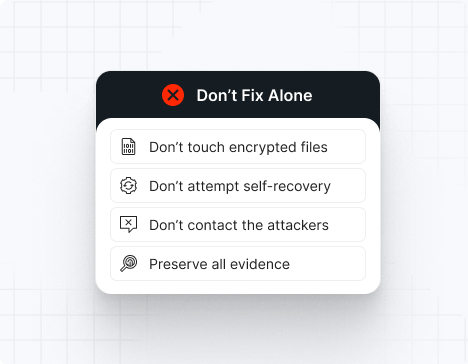
Note: Attempting to remove 8Base ransomware and self-remedy may lead to greater data loss.
To remove 8Base ransomware, immediately engage 8Base ransomware removal experts to guide your response and ensure no critical steps are missed. Then, begin by isolating all affected systems: disconnect compromised machines from the network (disable Wi-Fi, unplug Ethernet cables, and block their IPs at the firewall).
Next, perform a comprehensive forensic analysis to uncover the depth of the breach. Use endpoint detection and response (EDR) tools to trace the attacker’s path. Collect and review file-hash indicators of compromise (IOCs), registry changes, deleted Volume Shadow Copies, and any tampering with event logs. Check for persistence mechanisms in startup folders and registry run keys. After mapping the intrusion, reimage all infected devices using clean, verified system images.
Finally, rely on 8Base ransomware removal and recovery experts to validate the cleanup, conducting rootkit scans, reviewing system configurations, rotating compromised credentials, and reinforcing your security posture. Their specialized knowledge ensures thorough removal and helps prevent future incidents through strategic hardening and lessons learned.
How to recover from 8Base ransomware?
To recover from 8Base ransomware, follow these essential steps:
Immediately isolate affected machines to stop any further malicious activity, then only reintroduce them into production once you’ve verified clean restorations and confirmed there’s no lingering malware or backdoors.
Recover your data exclusively from offline, write-protected backups, and validate their integrity by checking checksums and performing test restores in a controlled environment before full deployment.
Perform a thorough post-incident review to map the attack chain and identify root causes, then harden or rotate all credentials (especially admin/service accounts and any credentials stolen via Mimikatz or LaZagne) to eliminate any leftover access points.
Bring in external IR specialists to audit your environment, ensure complete ransomware eradication, remove any persistence mechanisms, and help update your incident-response and business-continuity plans.
Ransom amounts
8Base ransom demands vary significantly based on the size of the victim organization and the amount of data stolen. Unlike some ransomware groups, 8Base primarily targets small and medium businesses, which affects their pricing strategy. Ransoms are typically demanded in Bitcoin or other cryptocurrencies.
Because 8Base conducts double-extortion attacks, victims face two simultaneous financial threats:
The ransom payment itself
The cost of leaked, stolen, or destroyed data and reputational damage
Organizations should never attempt ransom negotiation alone — 8Base operators are financially motivated despite their “penetration tester” branding, and they will publish stolen data on their leak site if negotiations stall or fail.
Average ransom demands:
Small business: $50,000 – $200,000
Medium business: $200,000 – $800,000
Large enterprise: $1,000,000+
*Note: Following Operation PHOBOS AETOR in February 2025, the 8Base infrastructure was disrupted and key operators arrested. However, affiliate operations may continue under different branding or through remaining network members.
 Platform
 UnderDefense Secures Top Honor at the 2025 Global Infosec Awards
Read More
UnderDefense Secures Top Honor at the 2025 Global Infosec Awards
Read More Our AI
 Anti-Phishing Playbook
Download the Playbook
Anti-Phishing Playbook
Download the Playbook Calculate your MDR price
Estimate MDR Cost
Calculate your MDR price
Estimate MDR Cost Company
 UnderDefense is an AWS Partner
Read More
UnderDefense is an AWS Partner
Read More